 Brightest Games
🎮✨ Random rewards only feel exciting when the player understands the frame around them. A rare drop, bonus trigger, critical hit, mystery chest, or slot spin can all create anticipation, but the reward lands cleaner when the basic action reads clearly. Good random systems leave the result open while keeping the player clear on what happened, what changed, and what they can do next.
That balance helps explain why random rewards have become such an important part of modern game design and why they appear in so many different genres, ranging from browser shooters and racing games to puzzle adventures, strategy titles, and loot-driven RPGs. Developers often use random rewards to create excitement, anticipation, and replay value, giving players a reason to keep playing and discovering new outcomes. However, randomness alone is rarely enough to keep players engaged for long periods. The most successful games carefully organize their reward systems so that players understand the possibilities and can make informed decisions while playing.
Surprise tends to be far more satisfying when players can connect it to a simple and understandable rule. If a player knows that defeating a boss may unlock rare equipment, opening a treasure chest may reveal valuable resources, or completing a challenge may grant a random bonus, the unexpected result feels exciting rather than confusing. The player may not know exactly what reward will appear, but they understand why the reward exists and how it was earned. This combination of uncertainty and clarity creates a stronger sense of satisfaction, because every surprise feels connected to meaningful gameplay rather than pure chance. Ultimately, the best game loops use randomness to create memorable moments while relying on clear rules and feedback to help players stay engaged, motivated, and eager to continue playing.
Random Outcomes Need Readable Rules!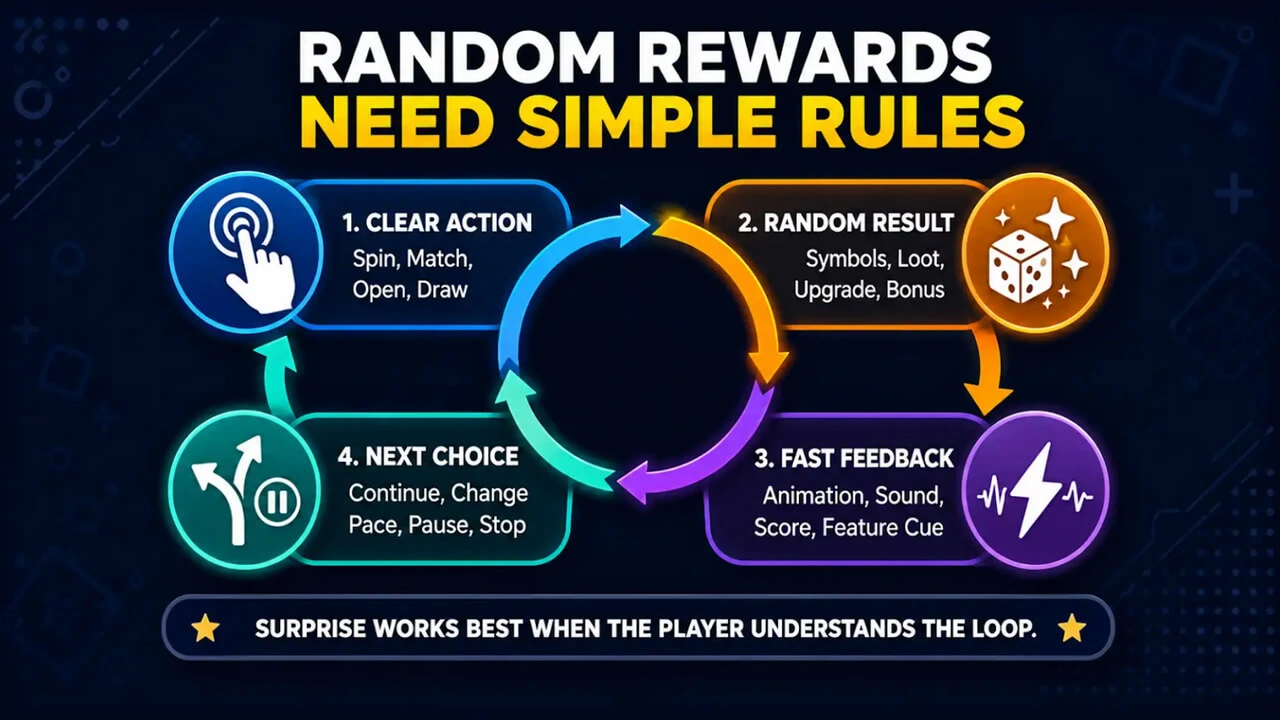
Slots are a clean example because every spin is random, yet the player can still understand the structure around it. Reels, symbols, paylines, bonus rounds, autoplay, feature labels, and return-to-player notes all give shape to a session. For anyone who wants to see those formats grouped in one place, Lucky Rebel Slots offers a wide range of popular formats, including progressive slots, hold-and-win games, bonus-buy games, pays-anywhere slots, fruit slots, gem slots, animal-themed slots, and candy-themed slots.
Three-reel and five-reel slots keep the action familiar through classic symbols and fast feedback. Ways-pays formats broaden how symbol combinations can land. Hold-and-win games make the bonus feature easier to recognize because selected symbols remain on the screen while the rest of the reels continue to spin. Bonus-buy games allow easy access to the game’s most iconic moments for players who want to jump straight into the main features. The page also explains RTP as an expected percentage over time, not a guarantee for any single session.
The same idea carries into session pacing. A player cannot control the result of a spin, a loot drop, or a bonus trigger, but they can control the amount set aside, the length of play, and the moment they stop. Lucky Rebel’s bankroll management guide uses the idea of fixed units: decide the size of a small unit before play, keep that unit steady, and avoid changing the rhythm because one result felt exciting or disappointing. For casual players, the useful part is deciding the boundary before the first spin.
Why Fast Feedback Makes Randomness Easier To Read?
Randomness becomes harder to follow when the game delays its answer. If a player presses a button, opens a chest, clears a wave, or spins a reel, the game needs to respond in a way that feels connected to that action. The result can still be unexpected. The connection should be obvious.
That is why quick feedback matters in casual games. A racing game gives instant information through speed, position, collisions, and lap time. A match game shows cleared tiles, dropped pieces, and score changes. A roguelite gives the player a random upgrade, then lets that upgrade affect the next room while the choice still feels fresh.
Simple Rules Give Surprise Somewhere To Land
The best random reward systems usually start with a plain base action, such as matching symbols, defeating a boss, finishing a race, opening a chest, clearing a level, or drawing a card. Once that action is clear, the game can add chance without turning the whole experience into noise.
The useful test is whether the player can explain the loop in one sentence. Match symbols to trigger a feature. Beat the boss for a chance at rare gear. Complete the daily run for a reward chest. Survive the wave and choose a random upgrade. The sentence only needs to keep the reward attached to an action that the player understands.
Trouble starts when random systems pile on too many labels. Rarity colors, upgrade tiers, seasonal currencies, crafting chances, event tokens, daily claims, and rotating reward tracks can all work alone. Packed together, they can make the player spend more energy decoding the system than playing. Depth is easier to enjoy when each layer has a job.
The Player Should Know The Kind Of Uncertainty First
Good games tell the player what kind of uncertainty they are dealing with. A loot game says the question is what drops. A puzzle game says the question is what piece appears next. A slot says the question is where the symbols land and whether a feature triggers. A roguelite says the question is which upgrade appears and how it changes the next few minutes.
That clarity changes the feel of the session. The player can accept an unexpected result when the rules around it are stable. Even frustration becomes easier to process because it has a shape: a missed jump, a failed combo, a low roll, a poor draw, a badly timed mistake. The game gives enough information for the player to decide whether to try again, change their approach, or stop.
For players, the practical move is simple. Choose games where the base action makes sense quickly, where feedback appears close to the action, and where random rewards are named clearly before they appear. Randomness adds energy, but the rules give that energy direction. That is why the strongest game loops keep uncertainty visible, readable, and tied to clear feedback, a point echoed by Frontiers in its discussion of gamification in teaching science.
Conclusion
Great games are not defined by how unpredictable they are, but by how clearly they communicate that unpredictability to the player. Whether it is a puzzle game, a roguelite, a racing title, or a reward-based experience, players stay engaged when they understand the rules and receive immediate, meaningful feedback. Random events can make every session feel exciting and fresh, but it is the structure behind those events that creates lasting enjoyment.
When players can recognize their mistakes, learn from outcomes, and see how their choices influence results, the gameplay loop becomes both satisfying and rewarding. The most memorable games combine uncertainty with clarity, giving players the confidence to keep playing, improving, and discovering new possibilities with every session.
Blog / Wiki / BrightestGames
Date Added: Monday, 22 June (GMT-5) 16:34 Time in Chicago, IL, USA
Related Articles: Why Short Online Games Are So Rewarding?
Browser Gaming Platforms Lead To Surge In Instant-Play Entertainment!
Video Content Dominance: Why It’s Winning Digital Marketing Video Is Now the Default Format?
From Puzzle Games To Casino Games: Why Simple Rules Keep Players Hooked?
Best Running And Parkour Games For PC And Mobile: Speed Stars, Rooftop Run And More!


