 Brightest Games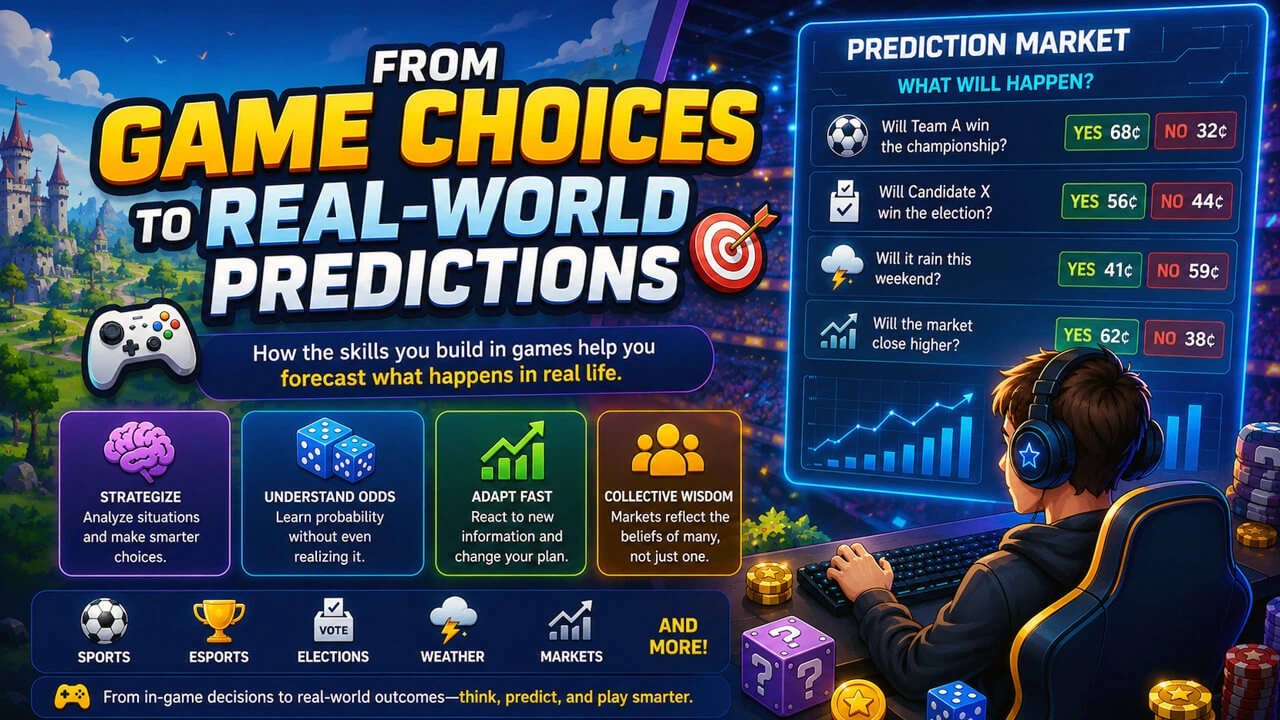
📊 Video games have always asked players to make choices under uncertainty: which unit to build, which route to take, which risk to accept for a bigger reward. What has changed recently is how closely those in-game decision structures resemble something happening outside of entertainment altogether. Prediction markets, tools that let people wager on the outcome of real events rather than fictional ones, borrow the same logic that makes strategy games and betting mechanics compelling.
This convergence is not accidental. Games designers have spent decades refining systems that reward accurate forecasting and quick adaptation to new information, and those same principles translate directly into how prediction markets operate. That bridge helps explain why platforms built around this idea have found an audience among people who already think in terms of odds and probabilities.
The Shared Logic Of Games And Forecasting Tools
🧠 Strategy games train players to constantly update their expectations as new information arrives. A card game player recalculates the odds of drawing a winning hand after every card played, while a real-time strategy gamer adjusts plans the moment an opponent reveals a new unit. This constant recalibration is essentially the same mental process used in probabilistic forecasting.
Prediction markets formalize this process by attaching a tradable price to a belief, and a bet on anything website illustrates how that pricing works in practice. If enough participants think an event is likely, the price of betting on that event rises, reflecting the collective judgment of everyone involved, similar to how gamers read the board and adjust strategy based on visible signals.
The overlap becomes clearer with fantasy sports and esports betting, both of which sit between traditional gaming and financial speculation. Players already track player statistics and team form to make in-game roster decisions. Applying that same habit to a prediction market, where the question might be "will this team win?" instead of "should I draft this player?" requires very little adjustment in mindset.
How Probability Thinking Develops Through Play
Repeated exposure to games with randomized outcomes, such as dice-based board games or card games with shuffled decks, builds an intuitive sense of probability long before any formal education on the subject. Players learn, often without realizing it, that a card with fewer copies has a lower chance of appearing, and they adjust their bets accordingly. This intuitive number sense becomes a foundation for reading odds elsewhere.
Digital games add another layer by displaying probabilities directly, such as a loot drop rate or a critical hit chance. Seeing these percentages repeatedly, then observing how often the predicted outcome actually happens, sharpens a player's ability to distinguish a genuinely rare event from something that only feels rare after an unlucky streak. That distinction matters in prediction markets, where mistaking short-term variance for a real trend leads to poor decisions.
Multiplayer games also introduce market-like behavior through in-game trading economies. Auction houses and player-driven marketplaces teach that prices move based on scarcity and demand, not fixed values. This is functionally identical to how a prediction market price shifts as more participants bet on one side, making the leap from virtual economies to real prediction platforms fairly natural.
Why Real-World Events Fit Naturally Into A Game-Like Structure
Real-world events, particularly sports, elections, and major cultural moments, already carry a narrative structure similar to games: a buildup, competing sides, and a resolution. This shape is part of why sports betting has existed for so long and why it maps so easily onto a game-like interface. Prediction markets extend that structure to a wider range of topics, including weather patterns and economic indicators.
What makes the format engaging rather than purely transactional is the feedback loop it creates. A person who predicts an outcome correctly receives a clear, immediate confirmation that their reasoning was sound, similar to winning a match. This feedback is more concrete than what most everyday decisions offer, since real life rarely gives such a clean answer about whether a choice was right.
The variety of available markets also mirrors the variety found in gaming libraries. A prediction market can offer questions ranging from political outcomes to entertainment results, letting participants engage with whichever domain matches their interest. This breadth keeps the experience from feeling repetitive, since the mechanic stays constant while the subject matter keeps changing.
From Entertainment Skill To Practical Insight
The skills sharpened through gaming- pattern recognition, probability estimation, and disciplined decision-making under uncertainty- do not stay confined to entertainment. They carry over into how people evaluate news, assess risk, and interpret statistics in media. Someone who has spent years reading in-game odds is often better equipped to question a vague statistic or spot when a claimed probability doesn't add up.
This transfer also works in reverse. As more people engage with prediction markets covering real events, they bring a sharper, more quantitative mindset back into how they discuss those events elsewhere. The habit of assigning a rough probability to an outcome, rather than treating it as a simple yes or no, becomes a more common way of thinking, and it often develops without any deliberate effort to learn it.
A Natural Progression, Not A Coincidence
The path from making choices in a game to making predictions about real events turns out to be a short one, built on decades of games teaching players to read probability, react to new information, and treat uncertainty as something manageable rather than something to fear. What looks like a new trend is really the natural extension of skills gamers have been building for a long time, now applied to questions that matter well beyond the screen.
A Gamer Conclusion!
The connection between gaming and real-world prediction is much closer than it might first appear. Every time players evaluate an opponent, calculate whether a risky move is worth taking, adapt to unexpected information, or estimate the probability of an outcome, they are practicing decision-making skills that extend beyond the virtual world. Games provide an interactive environment where uncertainty is constant, mistakes offer immediate lessons, and successful strategies develop through experience rather than theory alone.
For gamers, this makes probability more than a collection of percentages. It becomes something practical. A player learns that a 70 percent chance does not guarantee success, just as a 10 percent possibility does not mean an event can never happen. Card games, strategy titles, competitive multiplayer experiences, fantasy sports, and games with player-driven economies repeatedly reinforce this idea by forcing players to make decisions without having perfect information.
Prediction markets apply many of these familiar principles to real events. Instead of trying to predict what an opponent will do in the next round, participants might consider the possible outcome of a sporting event, election, economic development, weather event, or cultural moment. The subject changes, but the fundamental challenge remains surprisingly familiar: gather useful information, evaluate competing possibilities, recognize uncertainty, and update expectations when new evidence appears.
This does not mean that being good at games automatically makes someone an accurate real-world forecaster. Real events can involve far more complicated variables, unreliable information, emotional biases, and unexpected developments. Financial risk can also create consequences that simply restarting a game cannot erase. The valuable connection is therefore not about treating reality like another game, but about recognizing the analytical habits that gaming can help develop.
Perhaps the most useful lesson gamers can carry into prediction is the willingness to change their minds. Strong players rarely continue following a failing strategy simply because it was their original plan. They watch what is happening, recognize when the situation has changed, and adapt accordingly. That same flexibility is valuable when interpreting probabilities and making forecasts about events outside gaming.
Ultimately, From Game Choices To Real World Predictions highlights how years spent making strategic decisions on digital battlefields, football pitches, racing circuits, card tables, and virtual economies can encourage a surprisingly useful way of thinking. Gaming teaches us to observe patterns, question assumptions, manage uncertainty, consider risk, and understand that even a well-calculated decision cannot guarantee a particular outcome.
The worlds of games and forecasting may appear very different on the surface, but both reward curiosity, adaptability, and thoughtful decision-making. For gamers who already enjoy asking themselves, What is most likely to happen next?, exploring probability and forecasting can feel less like entering an unfamiliar world and more like applying an old gaming instinct to a much bigger playing field. 🎮
Blog / Wiki / BrightestGames
Date Added: Tuesday, 1 September 2026 (GMT-5) Time in Chicago, IL, USA
Related Articles: Why Short Online Games Are So Rewarding?
Browser Gaming Platforms Lead To Surge In Instant-Play Entertainment!
Video Content Dominance: Why It’s Winning Digital Marketing Video Is Now the Default Format?
From Puzzle Games To Casino Games: Why Simple Rules Keep Players Hooked?
How Is Blockchain Facelifting Gaming - 9 Newest Trends
The Impact Of WebGL And Unity On Browser Gaming
Level Up Your Gaming: Why Online Casinos Dominate Over Traditional Ones


