 Brightest Games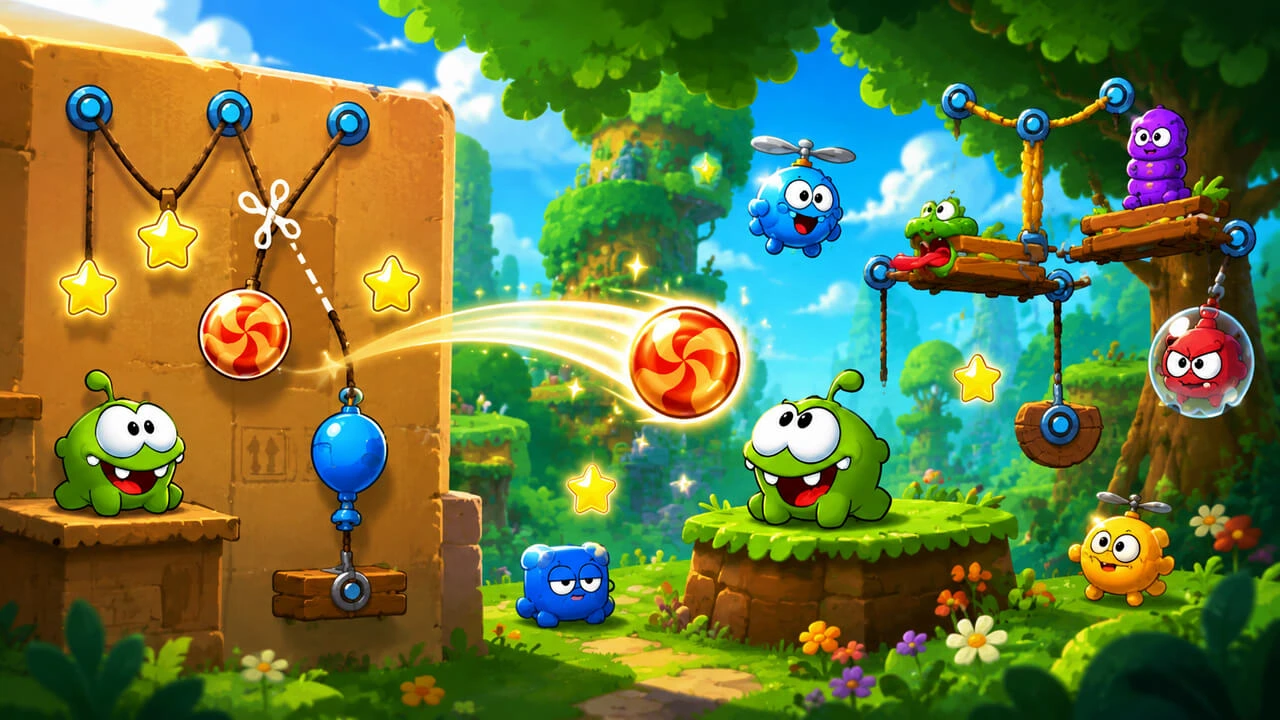
✂️ Sometimes the games that remain memorable for years are not the ones with the largest worlds or the most complicated controls. They are the ones that take one clever idea, make it instantly understandable, and then keep finding new ways to surprise the player with it. Few puzzle series demonstrate that better than Cut the Rope.
At the center of everything is Om Nom, a small green creature whose love of sweets has become one of the most recognizable elements of the franchise. ZeptoLab describes Om Nom as a curious, expressive character known for his endless appetite for anything sweet, but his personality turned what could have been a straightforward physics puzzle into something considerably more charming.
The objective sounds almost ridiculously easy when explained for the first time. There is a piece of candy hanging somewhere inside the level, Om Nom is waiting patiently for his favorite treat, and a collection of ropes, objects, obstacles, and physical forces stands between the two. Your job is simply to figure out how to bring them together, but that innocent little task quickly develops into something far more interesting than cutting the first rope you see.
Every rope can influence the direction and momentum of the candy, which means the order and timing of your actions can completely change what happens next. Cut one rope, and the candy might swing toward Om Nom, but cut another too early, and it could fall away from him entirely. Add stars to collect, bubbles that carry objects upward, air currents that push the candy across the screen, moving mechanisms, and increasingly complicated arrangements, and the simple goal begins to feel like a miniature physics experiment.
That is where much of the charm of Cut the Rope comes from. The game rarely needs to explain gravity, momentum, swinging, or trajectory with complicated instructions because players can see those forces working immediately. You experiment, watch what happens, understand your mistake, and try a slightly different solution. Sometimes the answer is obvious within seconds, while other levels encourage you to stare at the screen for a while before realizing that one carefully timed cut can set an entire chain of events into motion.
Reaching Om Nom is only part of the challenge as well. Players who want a better result need to think about the stars positioned around each puzzle, because the easiest path to the candy-loving creature is not necessarily the route that produces the best score. Suddenly, you are not only asking how to deliver the candy, but how to collect every available star along the way without ruining the trajectory.
🐸 This simple combination of an adorable objective and increasingly clever physics is what gives the series so much personality. Om Nom wants his candy, and you want to give it to him, but the game continually invents new and amusing ways to make that seemingly straightforward delivery much harder than expected. What begins with one candy and a few ropes gradually becomes a test of observation, timing, experimentation, and problem-solving, while remaining simple enough that almost anyone can understand the basic idea within moments of starting the game.
That simplicity is one of the reasons Cut the Rope games are so approachable. You do not need to memorize dozens of controls before understanding what is happening. Cutting one rope immediately demonstrates gravity. Leave another attached, and the candy begins to swing. Release it at exactly the right moment, and momentum carries the sweet toward its destination.
Then The Game Begins Asking More Interesting Questions
- Can you collect every star along the way?
- What happens when bubbles enter the puzzle?
- What if air currents alter the candy's trajectory?
- What if the obvious rope should not be the first one you cut?
Suddenly, something that appeared to be a children's puzzle becomes an exercise in timing, prediction, experimentation, and spatial reasoning. That combination helped establish the identity of the franchise. The colorful presentation makes the games welcoming, while increasingly complicated physics puzzles provide enough challenge to keep experienced players interested. Contemporary reviews of the original similarly highlighted the combination of accessible controls, clever puzzles, and personality.
More importantly, ZeptoLab did not leave the concept frozen in its original form. Cut the Rope: Experiments introduced the Professor and additional gadgets, with ZeptoLab currently describing 200 puzzles spread across eight level packs.
Cut the Rope: Time Travel sent Om Nom through different historical periods and introduced his ancestors into the candy feeding formula. BrightestGames currently offers the game alongside other entries from the series. Cut the Rope: Magic pushed the formula into fantasy and gave Om Nom six magical transformations across more than 160 puzzles.
Eventually, Om Nom Run demonstrated that the little green monster could even leave traditional rope puzzles behind and work as the star of an obstacle-based running game. Yet the most interesting comparison remains between the game that established the formula and the numbered sequel that attempted to expand it. That means returning to where everything began.
Cut The Rope 1: A Simple Idea With Surprisingly Deep Physics
The original Cut the Rope is a wonderful example of puzzle design built around immediate cause and effect. It takes an idea that can be understood almost instantly and gradually transforms it into a surprisingly clever test of timing, observation, experimentation, and basic physics.
- You see the candy.
- You see the rope.
You see Om Nom waiting underneath with his eyes fixed on his favorite treat.
- Naturally, you cut the rope.
- The candy falls.
- Om Nom happily eats it.
- Problem solved.
At least, that is how straightforward everything appears at the beginning. The game quickly stops making things quite that easy. Additional ropes begin changing the direction of the candy, stars encourage you to take less obvious routes, and new interactive elements make every movement more important. Bubbles, air blowers, pulleys, movable objects, and other mechanisms gradually complicate the journey, forcing you to think about how the candy will react before making your next move.
Soon, cutting a rope becomes only the first part of the solution. You may need to let the candy swing long enough to build momentum, release it at precisely the right moment, catch it with another mechanism, redirect its movement, collect a difficult star, and finally guide it toward Om Nom without losing control along the way.
That progression is important because Cut the Rope teaches primarily through interaction. Instead of overwhelming players with lengthy tutorials or complicated instructions, its physics communicate much of what they need to know. You act, immediately see the result, and gradually understand how each mechanic behaves.
- A swinging candy develops momentum.
- A floating object rises.
- An air current pushes something in a predictable direction.
- A rope controls the candy until you decide to cut it.
Once players understand those individual behaviors, the challenge becomes combining them into a complete solution. This creates an enjoyable learning process where experimentation rarely feels like wasted time. Even an unsuccessful attempt can teach you something useful about the level. Perhaps you released the candy too early, allowed it to swing too far, or collected two stars while completely missing the third. The next attempt becomes easier because you now understand the puzzle a little better. This is where Cut the Rope 1 becomes much more interesting than its adorable presentation initially suggests.
Behind Om Nom's funny expressions and constant appetite for sweets is a collection of miniature physics problems that reward both logical thinking and good timing. The game rarely asks players to perform complicated actions, but it frequently asks them to perform simple actions at exactly the right moment.
Imagine the candy hanging from two ropes.
Cutting the left rope causes it to swing toward the right.
Cutting the second rope too early sends it in the wrong direction.
Waiting too long might cause you to miss a star or lose the ideal trajectory.
Release it at exactly the right moment, however, and the candy can travel smoothly through the level, collect the stars, and land directly in Om Nom's waiting mouth. The solution therefore depends not simply on knowing which ropes to cut, but understanding when to cut them and in what order.
That tiny distinction creates enormous room for puzzle design. As the levels become more complicated, several mechanics can appear within the same puzzle, creating situations where one action triggers another. A successful solution can begin to resemble a carefully planned chain reaction, with the candy swinging, floating, falling, changing direction, collecting stars, and finally reaching Om Nom.
The three-star system adds another important layer. Simply feeding Om Nom may complete the basic objective, but collecting every star encourages players to search for more efficient and skillful solutions. The safest route is not always the best route, and sometimes obtaining that final star requires taking a risk that you could easily avoid if you only wanted to finish the level.
This gives Cut the Rope excellent replay value. A player can initially complete a difficult puzzle with one or two stars, then return later and attempt to discover the perfect three-star solution. Instead of making every player approach a level in the same way, the game provides room for both casual progress and more ambitious puzzle solving.
There is also something extremely satisfying about watching a complicated solution work exactly as planned. After several unsuccessful attempts, you finally cut the first rope at the right moment, watch the candy swing through a star, activate another mechanism, redirect its movement, collect the remaining stars, and send it perfectly toward Om Nom. What initially looked confusing suddenly feels beautifully logical.
That feeling of discovering the solution is one of the biggest reasons why the original Cut the Rope remains memorable. It manages to make physics understandable without turning the experience into a lesson, while making problem-solving entertaining without burying players under complicated rules.
At its heart, the game never forgets its wonderfully simple promise. There is still a hungry little green creature waiting for candy, and your job is still to feed him. Everything surrounding that objective becomes increasingly inventive, but the basic idea remains immediately recognizable from the first puzzle to the more challenging stages.
That balance between simplicity and depth is what makes Cut the Rope 1 such an important foundation for the entire series. Anyone can understand what needs to happen, but discovering the smartest way to make it happen is where the real fun begins.
The Three Star Challenge
Feeding Om Nom his candy is the basic objective of Cut the Rope, but collecting all three stars adds another layer of challenge that makes each puzzle much more interesting. Reaching Om Nom may be enough to complete a level, yet players who want the best possible result must think beyond the easiest solution and discover a route that collects every available star before the candy reaches its final destination.
This creates two different layers of success without making the game unnecessarily complicated. A beginner can concentrate on delivering the candy safely to Om Nom, learning how ropes, gravity, momentum, bubbles, and other mechanisms behave along the way. A more experienced player can look at the same puzzle and ask a much harder question. How can I feed Om Nom while collecting all three stars in a single successful attempt?
That difference gives the levels considerably more replay value. Even after discovering the basic solution, there can still be another challenge waiting. A player who initially finishes with one or two stars may return later with a better understanding of the mechanics and search for the perfect route.
Sometimes the safest path toward Om Nom is not the path that collects all three stars. One star might sit outside the candy's natural trajectory, forcing you to build additional momentum before releasing a rope. Another might require you to use a bubble, air blower, or other mechanism in a way that initially seems unnecessary. The final star could demand a perfectly timed cut that leaves almost no room for error.
Going for a perfect result therefore introduces an entertaining element of risk and reward. Do you take the simple route and safely feed Om Nom, or do you attempt a more ambitious swing that could collect another star but also send the candy completely off course?
The choice belongs to the player. This is especially satisfying because earning three stars usually feels like the result of understanding the puzzle rather than simply getting lucky. After several attempts, you begin recognizing the intended sequence of movements. You wait slightly longer before cutting one rope, allow the candy to build more momentum, collect a difficult star, and then release it at precisely the right moment to continue toward the next objective.
When everything finally works, the entire puzzle can unfold like a carefully planned chain reaction. That three-star structure also makes Cut the Rope welcoming to different types of players. Younger or more casual players can enjoy solving the main objective without worrying about perfection, while experienced puzzle fans can challenge themselves to complete levels as efficiently as possible and collect everything available.
It is a clever way of creating additional difficulty without changing the basic rules. The game does not suddenly become harder because enemies receive more health or because the controls become unnecessarily complicated. Instead, players create their own challenge by deciding how perfect they want their solution to be.
That approach helps explain why Cut the Rope works for such a broad audience. The basic objective is immediately understandable, but mastering every level can require considerably more observation, experimentation, patience, and precise timing. Feeding Om Nom may prove that you solved the puzzle, but collecting all three stars proves that you truly understood it.
Why Cut The Rope Still Works
The original remains enjoyable because its fundamental mechanic has barely aged. Gravity does not need a graphical upgrade to make sense. Momentum does not become obsolete. A well-designed timing puzzle remains a well-designed timing puzzle. The game also avoids one of the common problems of older casual titles: excessive complexity. You can understand what you are trying to accomplish almost immediately.
Mastering the increasingly complicated levels is another matter entirely. That distinction between easy to understand and difficult to perfect is one of the most important ingredients in the longevity of Cut the Rope. Players can currently experience Cut the Rope on BrightestGames directly in the browser. The BrightestGames version currently lists 425 puzzle levels across 17 boxes.
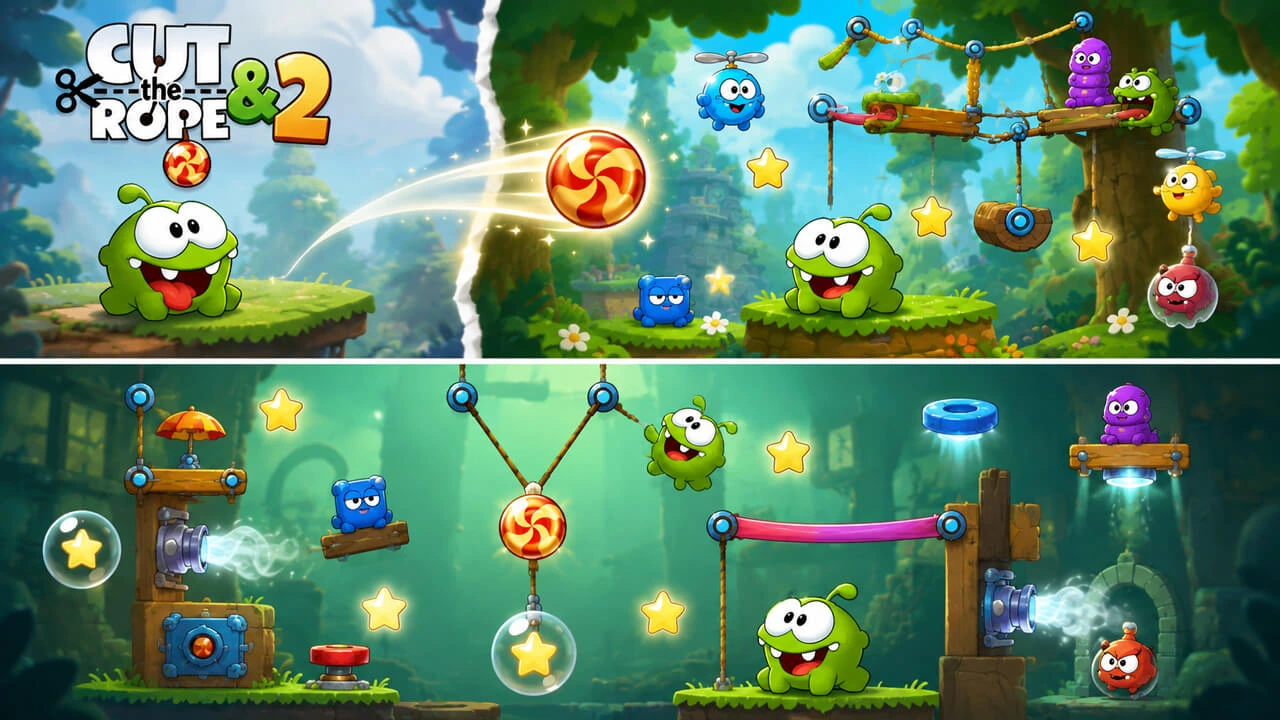
Cut The Rope 2: Familiar Candy, Much Bigger Possibilities
Creating a sequel to a successful puzzle game presents an unusual challenge. The developers need to introduce enough new ideas to make the next adventure feel worthwhile, while protecting the simple mechanics that made players enjoy the original game in the first place. Change too little, and players may wonder why a sequel was necessary. Change too much, and the game risks losing the simplicity, personality, and satisfying physics that made the original Cut the Rope so enjoyable. Cut the Rope 2 largely finds a comfortable middle ground.
- Candy still matters
- Ropes still matter
- Physics still matters
- Stars are still worth chasing
And, most importantly, Om Nom is still extremely hungry. However, the number of things that can influence a solution becomes considerably larger. Instead of replacing the familiar formula, the sequel expands it by giving players more objects, characters, environmental interactions, and possibilities to consider. The result feels recognizable from the first few puzzles, yet it gradually asks you to think about familiar situations in completely different ways. Read more about Cut the Rope 2 on Wikipedia and on Fandom, and also watch an online walkthrough on Brightest Games to know how to win each level.
Om Nom Becomes Part Of The Puzzle
One of the most important changes is that Om Nom himself can become part of the puzzle, rather than functioning primarily as the destination waiting for the candy. This might sound like a relatively small addition, but it changes the way players think about solving levels.
In the original game, your attention is usually focused on the candy. You examine the ropes attached to it, consider how gravity will affect it, study the available stars, and calculate which sequence of actions can eventually bring the sweet to Om Nom.
The sequel can make both sides of that equation important. Instead of asking only how you can bring the candy to Om Nom, you may also need to consider how Om Nom can be moved into the correct position to receive it.
That immediately creates more possibilities. Perhaps the candy cannot easily reach Om Nom's current location. Instead of manipulating the candy through an increasingly complicated route, the solution might involve moving Om Nom.
Another puzzle could require both the candy and Om Nom to change positions before they can finally meet. This gives the developers another variable to work with, and it gives players another reason to examine the entire level before making their first move.
Meet The Nommies
The biggest personalities behind many of these new possibilities are the Nommies, a collection of colorful creatures whose individual abilities influence Om Nom, the candy, obstacles, or the environment.
Rather than acting as decorative companions, these characters become genuine puzzle mechanics. Each one introduces another rule that players can learn, understand, and eventually combine with the familiar rope-cutting physics.
Roto can carry Om Nom through the level, allowing the hungry hero himself to travel toward locations that would otherwise be impossible to reach.
Lick can extend his tongue to create useful bridges, turning empty spaces into surfaces that can influence movement and provide new routes.
Blue can help lift Om Nom, introducing vertical movement and making his position another important part of the solution.
Toss can launch objects into the air, creating opportunities to send Om Nom, candy, or other useful elements toward places they could not reach naturally.
Boo can frighten Om Nom and cause him to jump, turning a funny character interaction into a useful movement mechanic.
Snailbrow can travel along walls and ceilings while pushing candy, adding another unusual way to manipulate the sweet without relying entirely on ropes.
Ginger can remove certain obstacles by burning through them, opening paths that initially appear blocked. Individually, these abilities are relatively easy to understand.
The real challenge begins when the game starts combining them. A level might require one Nommie to move Om Nom, another interaction to reposition the candy, and a carefully timed rope cut to bring everything together. What originally looked like a simple screen filled with colorful characters can suddenly become an interconnected physics puzzle where the order of every action matters.
More Tools Mean More Possible Solutions
These additions fundamentally increase the number of relationships a puzzle can contain. In the original game, players frequently ask one central question.
How do I manipulate the candy?
You examine the ropes, predict the swing, calculate the trajectory, and determine when to release it.
Cut the Rope 2 can ask a much broader question
How do I manipulate the candy, Om Nom, the Nommies, and the environment in the correct sequence?
That is a much larger puzzle vocabulary
The important thing is that the sequel does not simply make puzzles complicated for the sake of being complicated. The best new mechanics remain visually understandable, which means players can usually experiment with them and quickly learn how they behave. This follows one of the strongest design principles established by the original.
- You learn by doing.
- Activate something and watch what happens.
- Move Om Nom and observe where he goes.
- Use a Nommie's ability and see how it changes the environment.
- Cut a rope and study the resulting trajectory.
If your solution fails, the result often gives you enough information to improve your next attempt.
Familiar Physics With New Possibilities
Despite all these additions, the familiar physics remain at the heart of the experience.
Gravity still determines where unsupported objects fall. Momentum still affects how candy swings. Timing still determines whether a perfect trajectory succeeds or completely misses its target.
Ropes still need to be cut at the correct moment. Stars still encourage players to attempt more ambitious routes. This continuity is important because Cut the Rope 2 does not require fans to forget everything they learned in the first game.
Instead, it builds on that knowledge
If you already understand how to generate momentum by swinging candy from a rope, that knowledge remains useful. If you know that releasing an object slightly earlier changes its trajectory, the same principle continues to matter.
The sequel simply gives you additional ways to influence what happens before, during, and after that movement. As a result, experienced players can immediately recognize the foundation while discovering new layers on top of it.
Think About The Whole Level
Another consequence of the expanded mechanics is that players benefit from studying the entire puzzle before acting. In the original, spotting the ropes and stars might give you a reasonable idea of what needs to happen.
In Cut the Rope 2, you also need to consider the location of Om Nom, the available Nommies, environmental objects, and how all these elements might interact. Sometimes the most obvious first move is deliberately misleading.
You might see a rope that appears ready to be cut, but releasing it immediately could make collecting a star impossible. A Nommie might appear unnecessary until you realize its ability changes Om Nom's position.
An obstacle might initially look like something you need to avoid, only to become an important part of the correct solution. This encourages a more thoughtful approach. Instead of immediately cutting the first available rope, take a moment to examine the complete level.
Where does the candy need to travel?
Where does Om Nom need to be?
Which Nommie can influence either one?
Which stars can be collected along the route?
And most importantly, in what order should everything happen?
Answering those questions is where the sequel's deeper puzzle design begins to shine.
The Three Star Challenge Returns
The familiar pursuit of stars also becomes more interesting when additional mechanics enter the equation. Reaching Om Nom might be relatively straightforward, but collecting everything along the way can require a much more sophisticated sequence.
Perhaps Roto needs to move Om Nom while the candy takes another route. Maybe Lick's bridge must be activated at precisely the right moment. You could need Toss to send an object upward before using another mechanic to redirect it. The perfect solution becomes less about one clever cut and more about coordinating several actions.
This gives skilled players plenty of opportunities to revisit completed stages. Finishing a puzzle proves that you found a working solution. Collecting every star can prove that you discovered a much better one.
A Sequel That Expands Instead Of Replaces
That is ultimately what makes Cut the Rope 2 such an interesting sequel. It does not abandon the identity of the first game in an attempt to become something completely different.
- Om Nom still wants candy.
- You still manipulate physics.
- You still cut ropes.
- You still chase stars.
The satisfying cause-and-effect relationship between your actions and the objects on screen remains central to the experience. What changes is the number of ways those familiar ingredients can interact.
- Om Nom is no longer simply waiting at the finish line.
- The Nommies are not simply cute new faces.
- The environment is not merely a colorful background.
- All of them can become active pieces of the puzzle.
That expansion allows Cut the Rope 2 to feel larger without making its fundamental objective difficult to understand. A newcomer can still look at the screen and quickly recognize the basic goal, while an experienced player can appreciate how many additional steps may be required to achieve the perfect solution.
The original Cut the Rope asks players to become masters of candy physics. Cut the Rope 2 takes the next logical step by asking them to become masters of the entire playground surrounding that candy. And somewhere in the middle of all those ropes, stars, strange creatures, moving objects, and carefully planned chain reactions, Om Nom is still waiting for the same thing he wanted from the very beginning. One more piece of candy.
More Dynamic Puzzle Design
This difference was recognized when the sequel originally appeared. Contemporary reviews generally saw Cut the Rope 2 as an evolution rather than a complete reinvention. Pocket Gamer described it as more dynamic while acknowledging that it remained close to the fundamental swing physics, timing, and ingenuity of the original.
That is arguably exactly what a sequel like this needed. Cut the Rope did not require an entirely different identity. Its core idea was already excellent. It needed more possibilities. The Nommies provide those possibilities without making the basic goal difficult to understand. You still want the candy. You still want Om Nom to eat it. The difference is everything that can happen between those two points.
A Bigger Sense Of Adventure
Cut the Rope 2 also gives Om Nom's journey more environmental variety. Official descriptions send him beyond his familiar box and through forests, cities, junkyards, tunnels, and other locations while pursuing his favorite food.
This helps the sequel feel more like an adventure rather than simply another stack of isolated puzzle screens. The environments are not merely decoration either. Different Nommies and mechanics create distinct puzzle possibilities, giving each area its own rhythm. That makes progression feel more meaningful. You are not simply moving from level 20 to level 21. You are discovering another environment and learning another way the physics system can be manipulated.
Cut The Rope 1 vs Cut The Rope 2
This should become a major section of the full article. I would frame the comparison like this:
Pure Rope Cutting Foundation - Expanded physics interactions
Candy is the primary moving puzzle object - Candy and Om Nom become more dynamic
Simple environmental gadgets - More character-driven mechanics
Focus on ropes, gravity and timing - Greater focus on combining abilities
Compact puzzle presentation - Stronger sense of adventure
Excellent introduction to the series - Better choice for players wanting more variety
Learn the physics - Master the interactions
Neither game needs to defeat the other. The original demonstrates how powerful simplicity can be. The sequel demonstrates how much complexity can be added without destroying that simplicity. But Cut the Rope 2 is "better." You can read more in the Cut the Rope 2 Review. Also, a great mix of challenge and entertainment in the new and fresh Cut the Rope 2 review online.
Why Play Cut The Rope Games Online On BrightestGames?
Playing Cut the Rope games online on BrightestGames gives puzzle fans an easy way to explore several different chapters and related adventures from one gaming destination.
You can begin with the original Cut the Rope and discover why its mixture of candy, ropes, stars, physics, and Om Nom became so memorable. From there, you can explore different interpretations of the formula through Cut the Rope: Experiments, Cut the Rope: Time Travel, and Cut the Rope: Magic, or switch genres and see Om Nom in a completely different type of adventure with Om Nom Run.
Players who simply enjoy the underlying concept of cutting and manipulating ropes can also move into related puzzle games such as Cut the Monster 3 and Twisted Rope 3D. That variety makes the series particularly suitable for browser gaming. You can play a few puzzles during a short break, return to improve an unfinished three-star result, or spend considerably longer working through increasingly difficult stages. There is no complicated learning curve standing between you and the basic objective. Just look at the puzzle, understand the mechanics, make your move, and try to get that candy where it belongs. 🍬
Which Cut The Rope Game Is Best For Beginners?
For newcomers, the original Cut the Rope remains an excellent place to begin. Its early stages introduce the essential mechanics gradually, allowing players to become comfortable with ropes, swinging objects, gravity, momentum, and timing before the puzzles become more demanding. You can also choose how seriously you want to approach each challenge.
Simply want to progress?
Concentrate on feeding Om Nom.
Want a greater challenge?
Try collecting all three stars.
Want to completely master the level?
Experiment until you discover a solution that feels both efficient and satisfying. This flexible difficulty makes the original particularly welcoming for younger players and casual puzzle fans while still providing enough depth for players who enjoy hunting for perfect results.
Which Game Is Better For Experienced Puzzle Players?
If you already understand the original mechanics, Cut the Rope 2 is probably the more interesting choice. The sequel assumes that manipulating candy through physics is only part of what you can handle. By introducing the Nommies and making Om Nom himself more relevant to puzzle solutions, it increases the number of relationships you need to consider. Instead of concentrating exclusively on the candy's trajectory, you may need to think several steps ahead.
Where should Om Nom be positioned?
Which Nommie should be activated first?
What happens to the candy afterward?
Can you still collect every star?
Will using one ability too early make another part of the puzzle impossible?
Why Cut The Rope Games Still Work Today
Browser gaming has changed considerably since the original Cut the Rope became popular, but the fundamental appeal of its puzzles has not disappeared. Part of that longevity comes from the fact that the game is not dependent on complicated technology or enormous environments to be enjoyable. Its entertainment comes primarily from understanding a problem and experiencing the satisfaction of solving it. The visual language is also incredibly easy to read.
- Candy looks like candy.
- Ropes behave like ropes.
- Gravity pulls objects downward.
- Bubbles suggest floating.
- Stars invite you to collect them.
And Om Nom's expression makes it clear where the candy ultimately belongs. Players can understand much of what is happening simply by looking at the level. There is also very little wasted time between identifying a solution and testing it. If you think a rope should be cut, you can try it immediately. If your idea fails, you quickly learn something about the puzzle and can attempt another approach.
That quick cycle of observe, predict, experiment, fail, adjust, and succeed remains satisfying regardless of how old the original concept becomes. And when the final attempt works perfectly, there is still something strangely rewarding about watching the candy collect every star before dropping directly into Om Nom's mouth.
- Frequently Asked Questions About Cut The Rope -
1. What is the main objective of Cut the Rope?
The main objective is to manipulate ropes and other physics-based mechanisms so that the candy reaches Om Nom. Players can also attempt to collect all three stars available in a level for a more complete result.
2. What makes Cut the Rope different from ordinary puzzle games?
Cut the Rope combines logical problem-solving with interactive physics. Instead of simply selecting an answer, players manipulate ropes, momentum, gravity, bubbles, air currents, and other mechanisms to physically guide the candy through each puzzle.
3. What is the biggest difference between Cut the Rope and Cut the Rope 2?
The original focuses more heavily on manipulating candy through ropes and environmental gadgets, while Cut the Rope 2 expands the formula with the Nommies, more dynamic environments, and puzzles where Om Nom himself can become a more active part of the solution.
4. Who are the Nommies in Cut the Rope 2?
The Nommies are colorful helper characters with different abilities. Their powers introduce new ways to move Om Nom, manipulate candy, create paths, remove obstacles, and solve increasingly elaborate physics puzzles.
5. Is Cut the Rope suitable for beginners?
Yes. The basic objective is extremely easy to understand, while the puzzles gradually introduce more complicated mechanics. Beginners can concentrate on reaching Om Nom, while experienced players can challenge themselves to collect every star.
6. Why should players collect all three stars?
Collecting three stars creates an additional challenge and encourages players to find more complete solutions. The easiest route to Om Nom does not always collect every star, so achieving a perfect result can require better timing and more creative thinking.
7. Are all Om Nom games physics puzzle games?
No. While Om Nom became famous through the Cut the Rope physics puzzle series, the character has also appeared in different styles of games, including the running and obstacle-based gameplay of Om Nom Run.
If Om Nom's main adventures leave you wanting more, the wider selection of rope-cutting and physics puzzle games on BrightestGames offers several directions to explore. You can continue Om Nom's journey through the magical transformations of Cut the Rope: Magic, visit different historical periods in Cut the Rope: Time Travel, experiment with unusual gadgets in Cut the Rope: Experiments, or return to the beautifully simple physics of the original Cut the Rope. Players interested in similar puzzle concepts can also try Cut the Monster 3 and Twisted Rope 3D, which take the satisfaction of cutting, manipulating, and understanding objects into different styles of challenges.
Cut the Rope: Magic
Cut the Rope: Magic takes Om Nom's familiar candy hunting formula into a colorful fantasy world where magical transformations become part of the puzzle. Players still need to understand timing and physics, but Om Nom's special forms introduce new ways to overcome obstacles and reach seemingly impossible pieces of candy. It is a great next step for anyone who enjoys classic Cut the Rope but wants more imaginative mechanics.
Cut The Monster 3
Cut the Monster 3 moves away from Om Nom while keeping the satisfying idea of solving problems through carefully planned cuts. Instead of delivering candy, players must examine each stage, interact with its mechanisms, and determine the correct sequence needed to deal with the monsters. It fits naturally alongside Cut the Rope for players who enjoy cutting puzzles where timing and experimentation matter. Also watch an online walkthrough on Brightest Games to know how to win each level.
Cut the Rope: Time Travel
Cut the Rope: Time Travel sends Om Nom on a candy-filled journey through different periods of history, giving the familiar physics formula a playful new setting. The puzzles introduce Om Nom's ancestors and require players to think about delivering candy while dealing with increasingly creative level arrangements. It keeps the accessibility of the original while making the adventure feel larger and more varied. Also watch an online walkthrough on Brightest Games to know how to win each level.
Cut the Rope: Experiments
Cut the Rope Experiments feels like the original game's physics playground has been moved into a laboratory. Familiar rope cutting and candy swinging return, but additional gadgets and experimental mechanisms create new opportunities for clever chain reactions. Players who enjoyed mastering momentum and timing in the first Cut the Rope should feel immediately comfortable while still finding plenty of new situations to solve. Watch an online walkthrough on Brightest Games to know how to win each level.
Cut The Rope
Cut the Rope is the ideal starting point for understanding why Om Nom became such a recognizable puzzle character. The objective is wonderfully simple: cut ropes and manipulate the environment until the candy reaches the hungry green creature, but increasingly clever combinations of gravity, momentum, bubbles, stars, and other mechanisms give the game surprising depth. Easy to understand and increasingly difficult to master, it remains an excellent introduction to physics puzzle gaming. Watch an online walkthrough on Brightest Games to know how to win each level.
Twisted Rope 3D
Twisted Rope 3D is a good alternative for players who enjoy the rope-based problem-solving side of Cut the Rope but want something different from candy delivery. Its puzzles revolve around examining tangled ropes, understanding how they connect, and working out the correct sequence of moves to untangle increasingly complicated arrangements. The result is a relaxing but satisfying logic experience that rewards patience and careful observation. Watch an online walkthrough on Brightest Games to know how to win each level.
Gamer Conclusion
More than anything else, Cut the Rope proves that a great game does not need a complicated idea to become memorable. The original starts with something almost absurdly simple. A piece of candy hangs from a rope, a hungry green creature waits nearby, and the player needs to bring the two together.
From that tiny idea comes an entire playground of gravity, momentum, timing, bubbles, stars, gadgets, experimentation, and increasingly clever puzzle design. Cut the Rope 1 shows how much depth can come from simplicity. It teaches players to observe how objects behave, predict what will happen after each cut, and understand that timing can be just as important as choosing the correct action.
Cut the Rope 2 takes that foundation and asks what else can be done with it. The answer is quite a lot. Om Nom becomes more involved, the Nommies introduce new abilities, environments become more adventurous, and puzzle solutions begin depending on combinations of characters and mechanics rather than ropes alone.
Yet underneath all those additions, the heart of the experience remains wonderfully familiar. Om Nom still wants his candy. That continuity is exactly why neither game needs to defeat the other. The first game represents the elegance of a brilliant idea stripped down to its essentials. The second represents what can happen when developers carefully expand that idea without forgetting why people enjoyed it in the first place.
And perhaps that is the best explanation for why the Cut the Rope series became a physics puzzle icon. Players came for the simple satisfaction of cutting a rope and watching physics take over. They stayed for the increasingly clever puzzles, the pursuit of perfect three-star solutions, and a little green creature whose excitement over one piece of candy somehow made solving everything feel worthwhile. Play and have fun with many cool online games here on Brightestgames.com.
Blog / Wiki / BrightestGames
Date Added: Monday, 17 August 2026 (GMT-5) Time in Chicago, IL, USA
Related Articles: Why Short Online Games Are So Rewarding?
Browser Gaming Platforms Lead To Surge In Instant-Play Entertainment!
Video Content Dominance: Why It’s Winning Digital Marketing Video Is Now the Default Format?
From Puzzle Games To Casino Games: Why Simple Rules Keep Players Hooked?
The Free Browser Games Dominating 2026!
Why Some Games Grab You Instantly, Others Don't?
From Game Choices To Real-World Predictions


